AI Can Write the Content. But Who Is Doing the Thinking?
By Monica Tomasso · · 5 min read
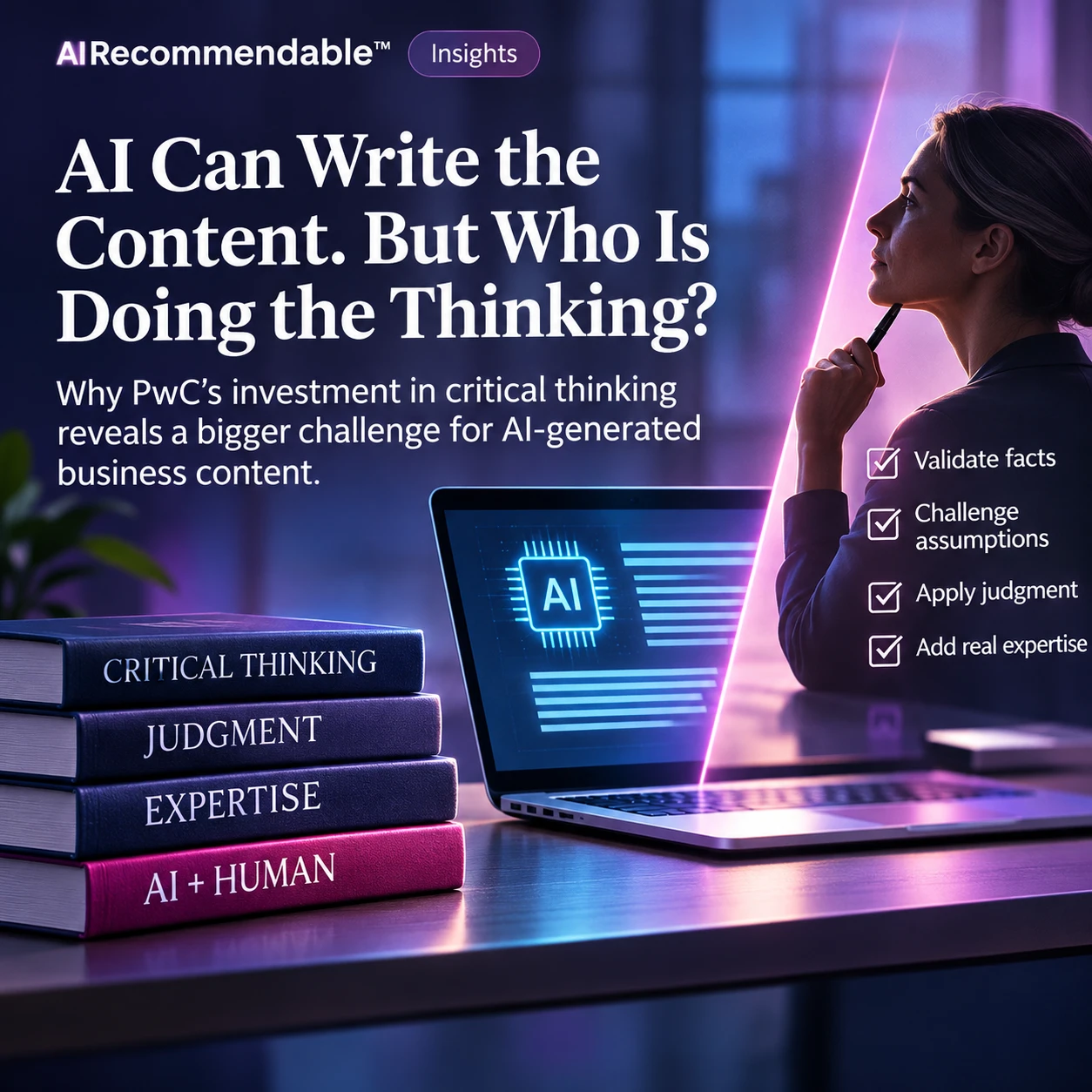
AI can write an article in seconds.
It can generate detailed industry analyses, create a company's FAQs, organize technical explanations, and turn a conversation into dozens of pieces of content.
But there is something it cannot reliably do on its own.
Determine whether what it has written accurately represents the expertise, judgment, and real-world experience of the business behind it.
And that distinction is becoming increasingly important.
PwC is investing in the skill AI cannot replace
On November 9, 2026, PwC announced a Critical Thinking & Judgment Certificate program for more than 85,000 professionals.
The initiative is designed to strengthen employees' ability to evaluate information, challenge assumptions, and exercise sound judgment as artificial intelligence takes on more foundational work.
The announcement, also covered by State of AI, highlights something worth examining.
One of the world's largest professional services firms is investing in human judgment precisely because AI is becoming so capable at producing work.
The issue isn't that AI cannot generate convincing answers.
It's that convincing answers and correct answers aren't always the same thing.
In business, that distinction matters enormously.
The same challenge exists in AI-generated content
I see a version of this challenge in my own work.
At Monic AI Systems, we've developed AIRecommendable, a platform that researches what buyers ask AI, captures business expertise through conversations, and helps transform that knowledge into structured, machine-readable content.
The technology can accelerate work that once required hours of interviewing, writing, research, editing, and organization.
But businesses need to understand something important.
AI-generated content is a starting point for expert evaluation, not a replacement for it.
Imagine an enterprise software company reviewing an AI-generated article about system integrations.
The article might be beautifully organized. It might explain APIs, implementation considerations, and common business challenges in perfectly fluent language.
But does it accurately describe that company's capabilities?
Are the technical assumptions correct?
Does the company support the integration described?
Would its engineers agree with the recommendations?
Those are not simply proofreading questions.
They require professional judgment.
Human in the loop should mean more than fixing grammar
For too long, the phrase "human in the loop" has been treated as a final editorial checkbox.
Read the content. Correct a few sentences. Approve publication.
That isn't enough.
Meaningful human involvement requires examining the substance of what AI produces.
A subject-matter expert needs to challenge assumptions, correct unsupported claims, supply missing context, and identify where the content fails to reflect what the organization actually knows.
The AI system has responsibilities, too.
It should not ask clients to repair generic, poorly researched drafts or validate claims without supporting evidence.
A well-designed AI content system should make expert review easier by producing grounded, relevant work and identifying uncertainties.
That is the distinction between using AI to manufacture content and using AI to help communicate expertise.
The founder's knowledge is the missing ingredient
Most companies already possess information that no general-purpose AI model can fully reconstruct.
It lives in their founders' experiences.
Their engineering teams.
Their customer conversations.
Their project decisions.
Their mistakes, lessons, processes, and results.
Much of that knowledge never makes it onto a website.
Instead, websites contain polished descriptions of services that sound remarkably similar to their competitors.
This is part of the problem we are trying to solve with AIRecommendable.
Rather than beginning with a blank prompt asking AI to write an authoritative article, we begin by capturing what someone genuinely knows.
A founder interview can reveal why a decision was made, what a client misunderstood, how a difficult problem was solved, or what the company does differently.
AI can then help organize that knowledge into accessible explanations, connected articles, FAQs, and supporting content.
The expert must still review and approve the result.
AI supplies the scale. The human supplies the experience, accountability, and judgment.
What PwC's investment in critical thinking means for AI visibility
The connection between PwC's initiative and AI visibility is worth examining.
Businesses are increasingly focused on whether they appear in answers from ChatGPT, Claude, Gemini, Perplexity, and other AI systems.
But appearing in an answer is not the same as being accurately understood.
A company might publish dozens of AI-generated articles and still fail to communicate what differentiates it.
Worse, inaccurate technical claims, exaggerated capabilities, or generic descriptions can weaken the information available about that business.
This is why human judgment matters.
AI visibility isn't simply about producing more content for machines to encounter.
It's about making real expertise discoverable, understandable, and verifiable.
When a founder explains why a process works, when an engineer corrects an implementation claim, or when a client contributes an actual business example, the resulting content can provide information that generic AI-generated copy does not.
That is valuable to human buyers and potentially useful to AI systems interpreting relevant sources.
It does not guarantee that an AI assistant will cite or recommend the company.
But it creates a stronger foundation for trustworthy digital authority.
From publishing more content to publishing more trustworthy knowledge
The industry has become obsessed with content velocity.
How many articles can we generate?
How many pages can we publish?
How quickly can we fill topic gaps?
But volume is not the same as authority.
In its official guidance on generative AI content, Google emphasizes accuracy, quality, relevance, and manual fact-checking before publishing AI-generated material.
Google also warns that generating large volumes of content without providing meaningful value can violate its spam policies.
The lesson is important.
The objective shouldn't simply be to publish enough information that an AI assistant encounters your business.
It should be to make your expertise easier to discover, understand, verify, and use.
That requires more than a writing model.
It requires a process for capturing evidence, validating claims, connecting knowledge, and maintaining editorial accountability.
The next competitive advantage is judgment
PwC's initiative reflects a broader change in how knowledge work is being valued.
When almost anyone can generate a competent-looking first draft, the differentiator shifts.
It becomes the ability to recognize what is missing.
To challenge what sounds plausible.
To know when the answer is incomplete.
To contribute expertise that isn't already available everywhere else.
This is particularly relevant as businesses compete to be included in AI-generated recommendations.
No platform can guarantee that a business will be cited or recommended.
But businesses can improve how clearly and credibly their expertise is represented across the web.
That work begins with a simple principle.
The future of AI content isn't removing the human from the process. It's making human expertise more valuable, more accessible, and easier for machines to understand.
The question is no longer whether AI can write your content.
It's whether the content reflects something your business actually knows.
From the founder: Monica Tomasso explores what her own AI content-development experience reveals about editorial judgment in The AI Content Problem Isn't Writing. It's Judgment. on Monic AI Systems.
Sources
- PwC: Critical Thinking & Judgment Certificate Program (November 9, 2026)
- State of AI: PwC Is Making Its Entire U.S. Staff Get Certified in Critical Thinking (November 9, 2026)
- Google Search Central: Guidance on Generative AI Content
Monica Tomasso, Founder, Monic AI Systems. Monica Tomasso is the founder of Monic AI Systems and AIRecommendable™, a platform focused on helping organizations translate real-world expertise into structured, discoverable information for AI-driven search and recommendations.